
FDA Approves New Treatment for Advanced Form of Kidney Cancer
FDA Approves New Treatment for Advanced Form of Kidney Cancer

The FDA has approved Votrient (pazopanib), the sixth drug to be approved for kidney cancer since 2005.
Votrient is an oral medication that interferes with angiogenesis, the growth of new blood vessels needed for solid tumors to grow and survive.
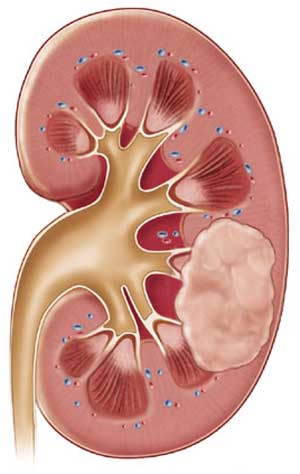
The medication is intended for people with advanced renal cell carcinoma, a type of kidney cancer in which the cancerous cells are found in the lining of very small tubes (tubules) in the kidney. In 2009, approximately 49,000 people were diagnosed with renal cell carcinoma and 11,000 people died from the disease.
"The last five years have seen dramatic improvements in treatment options for patients with kidney cancer. Before 2005, the options available offered only limited effectiveness," said Richard Pazdur, MD, director of the Office of Oncology Drug Products in the FDA's Center for Drug Evaluation and Research.
The five other drugs approved for kidney cancer and their approval dates are Sorafenib (December 2005), Sunitinib (January 2006), Temsirolimus (May 2007), Everolimus (March 2009) and Bevacizumab (July 2009).
The safety and effectiveness of Votrient was evaluated in a 435-patient study that examined a patient's progression-free survival, which is the length of time, following enrollment in the study, before the tumor began growing again or before the patient died. Progression-free survival averaged 9.2 months for patients receiving Votrient compared to 4.2 months for patients who did not receive the drug.
Adverse reactions included diarrhea, high blood pressure, hair color changes, nausea, loss of appetite, vomiting, fatigue, weakness, abdominal pain and headache. Votrient can also cause severe and fatal liver toxicity. Healthcare professionals should order blood tests to monitor liver function before and during treatment with the drug. Since Votrient can harm a fetus, it should not be used during pregnancy.
The drug has also been associated with heart rhythm irregularities. Patients receiving Votrient should be monitored with periodic electrocardiograms, which measure heart rhythm, and blood tests to monitor electrolytes since an electrolyte imbalance can lead to an irregular heart rhythm.
Votrient is made by GlaxoSmithKline.
Contact:
Karen Riley
301-796-4674,
karen.riley@fda.hhs.gov
All information on this site is provided “as-is” for informational purposes only and is not a substitute for medical advice or treatment. You should consult with a medical professional if you have any questions about your health.
More health news
 Prescription Drugs
Kidney Cancer Drug Updates
Renal cell carcinoma phase III clinical trial data presented at ESMO
 Health News
FDA Rejects Potential Kidney Cancer Rx
Tivozanib does not gain FDA approval for advanced renal cell carcinoma
 Prescription Drugs
Pfizer Reports Results From Torisel Study
Drug evaluated in patients with advanced renal cell carcinoma